Chinese herbal menopause medicine
The transition is a natural phase in which the balance of Yin, Yang, Qi and Blood can change. This can lead to complaints such as tiredness, sleep problems and mood swings. From Chinese medicine, acupuncture and herbal therapy support the body in restoring balance and vitality during this transition.
Menopause is a natural transition phase in a woman's life. Not only hormones change; the inner balance of Yin and Yang, Qi and Blood also requires attention. Many women experience during this period:
- Fatigue and lower resilience
- Mood changes or emotional sensitivity
- Worse sleep, anxiety, or night sweats
- Constipation or slow digestion
- Drought signs
- Feeling of instability or “not being well founded”
Traditional Chinese medicine (TCM) does not look at individual complaints, but at the whole and the underlying balance. With this blog, we look at how we can restore balance during the transition with Chinese herbal therapy.
The transition from a TCM perspective
In Chinese medicine, menopause is the time when kidney energy gradually decreases. This is a natural process, but can cause complaints when the body has consumed more than built up for a long time.
Common transition patterns include:
- Nier Yin deficiency
- dryness
- inner turmoil
- feeling of warmth
- night sweats or poor sleep
- Nier Yang deficiency
- weariness
- feeling cold
- less resilience
- less desire to be active
- possible problems with bowel movement, loose stools
- Disrupted cooperation between the Liver, Heart and Kidneys
- mood swings
- Mull
- varying emotional
As seen above, both Yin and Yang can become out of balance in this phase. A helpful comparison is that of a candle: Nier Yin is the wax, Nier Yang the burning flame.
- Too little Yin causes too fast combustion: the fire burns brightly but restlessly.
- Too little Yang actually causes too slow a burn, with symptoms such as fatigue and a feeling of cold.
In the form of Blood, Yin is also the coolant of our body. When it decreases, the system can overheat, which results in symptoms such as redness and hot flushes.
In this phase, herbs can help nourish, stabilize and anchor the body, instead of further forcing the system.
Herbs that support Yin and Yang
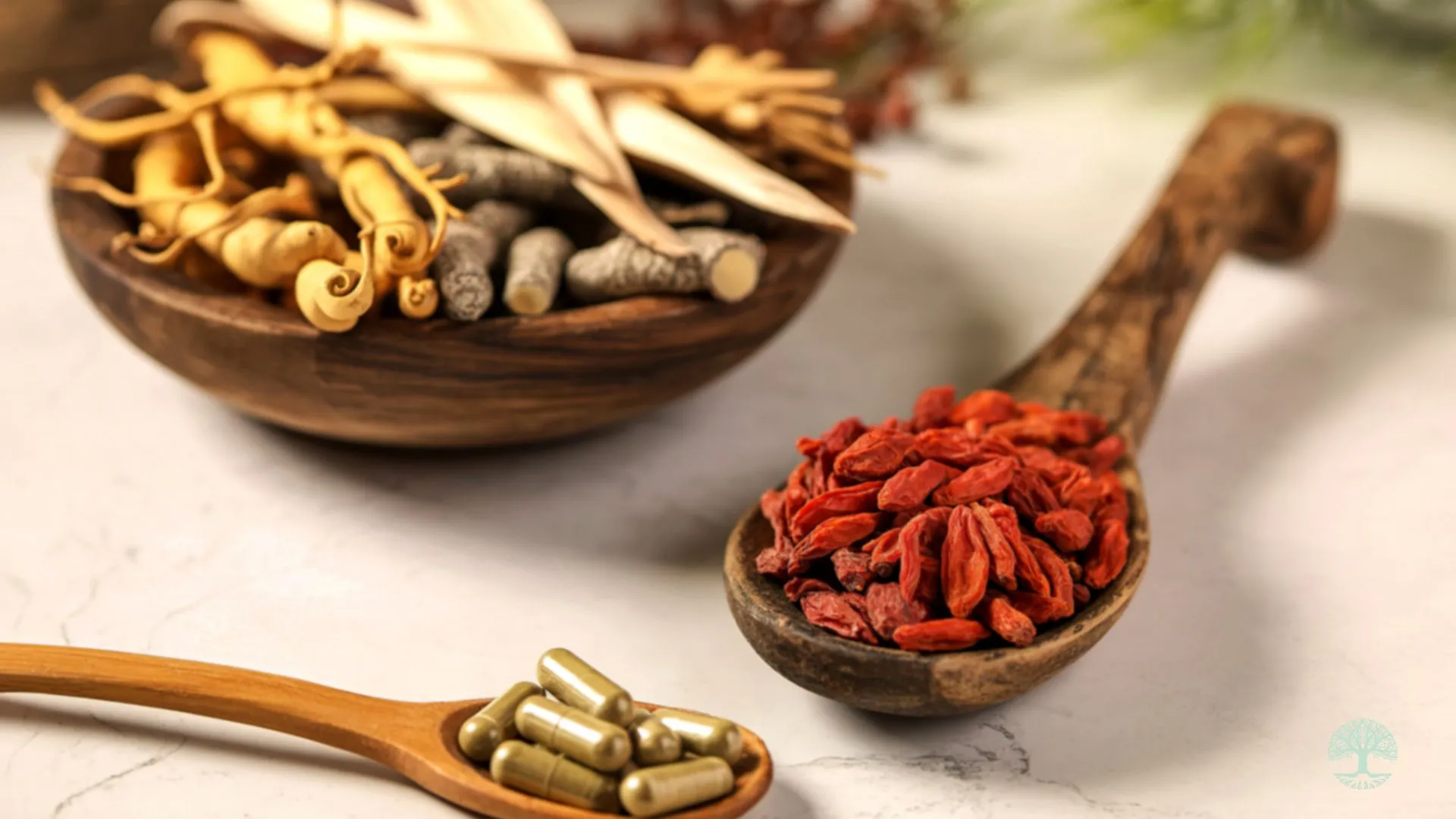
Chinese herbal medicine is very special; countless herbs are classified by taste, temperature and function. This provides insight into what they can do for the energy and balance in the body. Here are some examples:
Xian Mao (Curculigo rhizoma)
- Strengthens Nier Yang
- Supports warmth, energy and vitality
- Helps with tiredness and a sense of inner emptiness
- Always used carefully and combined with nourishing herbs
Sheng Di Huang (Rehmannia root)
- Nourishes Yin and Blood
- Calms inner turmoil
- Supports system recovery and hydration
Synergy: Xian Mao + Sheng Di
- Activate the fire without exhausting Yin
- Brings a balance between activation and nourishment
- Suitable for both fatigue and inner turmoil
Shan Zhu Yu (Cornus fruit)
- Strengthens and Preserves Essence (Jing)
- Reduces energy loss
- Provides a sense of strength and continuity
Wu Wei Zi (Schisandra berry)
- Anchors the Mind (Shen)
- Supports stress resistance
- Promotes emotional stability and focus
Synergy: Shan Zhu Yu + Wu Wei Zi
- Helps maintain energy
- Soothes hormonal fluctuations
- Supports adaptation to change
An extra layer: Nourishing blood
During the transition, it is possible blood become less rich, which affects both the body and emotions. Complaints that are appropriate here are:
- Tension in the body
- Irritability or emotional sensitivity
- Menstrual complaints or bleeding
- Cramps or restless sleep (e.g. restless legs)
Bai Shao (Paeoniae radix alba)
- Nourishes Blood and Yin
- Soothes the Liver
- Helps with tension and irritability
Dang Gui (Angelica sinensis)
- Nourishes and lets Blood Circulate
- Supports flexibility and recovery
- Traditionally used for women in transition phases
Synergy: Bai Shao + Dang Gui + Shu Di
- Harmonizes and nourishes Blood
- Provides support for emotional and physical changes
The spiritual journey from Yin to Yang
With age, the Yin gradually decreases. This creates relatively more space for Yang, not only physically but also spiritually. The first half of life is often about building up: a body, a family, a profession, a place in the world. In the second half of life, attention is increasingly shifting to meaning and transmission — what do we want to share, what do we leave behind?
Especially in this phase, it can be helpful to make space for meaningful activities: activities that touch and nourish you. This can be creativity, such as art or music, but also reading, writing, reflection, mindfulness or religion. When you pay attention to what your soul needs, the body also gets new nourishment and recovery space.
For example, meaning and inner deepening not only support the mind, but they also help to keep Yin and Yang in balance.
Finally: herbal therapy as an accompaniment to menopause
The transition is different for every woman. What helps one person may be too much or too little for another. That's why herbal advice is most effective when it:
- is tailored to your current balance
- takes energy, emotions and lifestyle into account
- moves with changes over time
An herbal consultation can help clarify what suits you right now. By looking at your complaints and constitution together, herbal advice is created that supports you in this transition, in a way that suits your body and life.
You can do this yourself!
You can add the following food to soup, porridge, or make a delicious tea:
- Hei Zhi Ma (Black Sesame Seed)
- Nourishes Liver and Kidney Yin, helps with constipation, dryness and fatigue
- Gou Qi Zi (goji berry)
- Nourishes Blood and Yin, supports energy, eyes and emotional resilience
- Sang Shen (mulberry berry, black)
- Nourishes Blood and Yin, supports bowel movements and calms emptiness
- He Tao Ren (walnut)
- Strengthens Kidney Yang, supports brain, energy and lower back
- Shan Yao (Chinese yam)
- Strengthens Spleen & Kidney, supports digestion and hormone balance
- Da Zao (Chinese date/jujube)
- Nourishes Qi & Blood, calms emotions, supports digestion
These self-care options are not medication, but daily support. They work best:
- in small amounts
- by taking them regularly
- tailored to your constitution
In case of doubt or varying symptoms, herbal advice is valuable in understanding what suits you at the moment, and what you should (still) leave behind.
Read more
- See how we can help you with relaxed
- Learn more about our herbal therapy