How does acupuncture work?
Acupuncture is based on principles of Chinese natural philosophy, which focus on balance and harmony. By understanding the body through Yin and Yang, the five elements and meridians, we not only look at complaints, but at the underlying pattern. Acupuncture controls processes and supports the body's self-regulating ability.
How does acupuncture work?
During treatments, I regularly get asked this question: how does acupuncture actually work? To give a good answer to that, it is necessary to take a moment to consider the way of thinking and philosophy that gave birth to acupuncture.
Acupuncture has a clear philosophical background. By observing nature and realizing that humans are part of it, principles about life, health and disease have been developed in Chinese medicine. These principles still form the basis of the treatment today.
What is health?
An important starting point in Chinese medicine is that humans are part of nature. Health occurs when there is harmony between the body and its environment, both internally and externally. When this coordination is disrupted, complaints can arise.
This idea of harmony and balance underpins how health and illness are understood.
Yin and Yang: the basis of life
In Chinese medicine, the functioning of the body is described using Yin and Yang. These are abstract concepts that represent the fundamental qualities of life. Everything can be viewed in terms of Yin and Yang, always in relation to each other.
Yang is associated with movement, warmth, and outward activity. Yin stands for peace, coolness and inward-looking quality. These opposites do not exist separately, but complement each other and constantly merge.
Yin and Yang control each other, feed each other and keep each other in balance. When this balance is present, there is harmony and health. When this balance is disturbed, disharmony occurs and complaints or illness can occur. In Western medicine, this striving for balance is often referred to as homeostasis.
The five elements
Yin and Yang form the basis, but in order to further understand processes in the body, the doctrine of the five elements, also known as five phases, is used. This teaching deepens the Yin-Yang principle and describes how different processes relate to each other.
The five elements are:
— Wood
— Fire
— Earth
— Metal
— Water
These elements are not fixed, static components, but dynamic processes, each with its own character. They are used to make connections between organs, functions, emotions and complaints. Through this simplification, complex processes in the body can be better analyzed.
An example of this is heat in the body, which can manifest itself in redness. The question then is not only where the heat is, but also why it occurs. Is there a shortage of cooling processes, or is there excessive activity due to stress or overload?
So inside, so out
Another important principle is that humans are seen as a small reflection of nature. The same laws that apply outside us also work inside the body. This is often summarized as: so inside, so out.
Within this vision, the body is one whole. A disturbance on the inside can occur on the outside, and vice versa. Complaints are therefore never seen separately from the overall system.
Meridians and acupuncture points
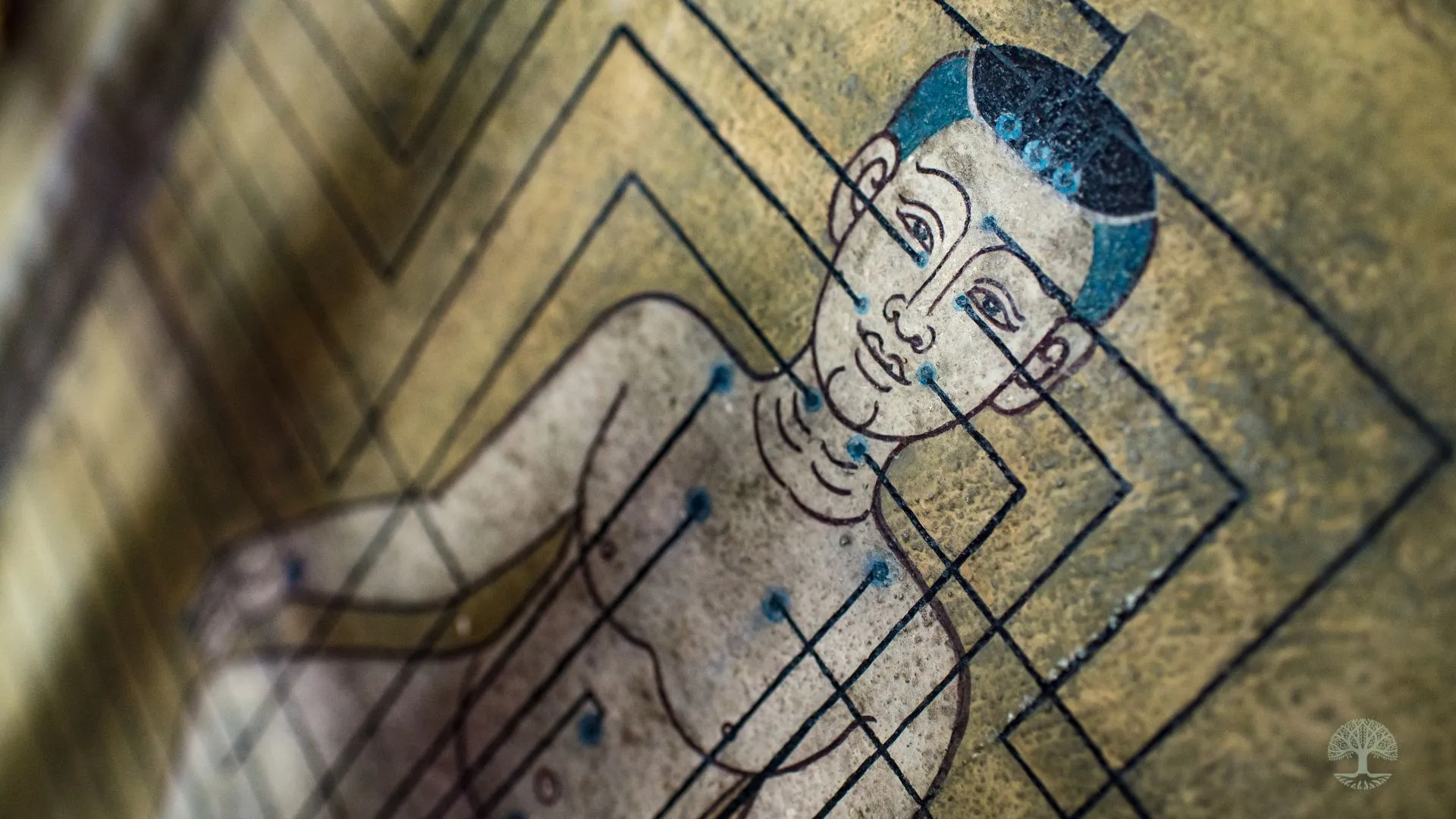
In Chinese medicine, the body is seen as consisting of networks that are connected to the five elements. Linked to this are the meridians: functional pathways that run through the body and connect different structures.
Exactly what a meridian is is difficult to describe in one word. You can see it as a functional structure that influences organs, muscles, fascia, blood and nerve tracts through location and coherence.
If the meridian is like a water pipe or electricity cable, acupuncture points are the taps and switches. By stimulating these points, an influence can be exerted on the functioning of the system as a whole.
Restoring balance with acupuncture
The goal of acupuncture is to restore balance in body and mind. This is done based on the principles of Yin and Yang and the five elements. This first requires a diagnosis: an understanding of the situation within this Chinese way of thinking.
Based on this, acupuncture points are chosen that match the pattern. For example, when there is too much heat due to insufficient cooling, the treatment can focus on supporting processes that provide cooling and recovery.
How can a small needle have an effect?
A common question is how such a small needle can affect the entire body. The aforementioned comparison with cranes and switches can help with this. Another comparison is that of a waterbed: pressure or movement on one side affects the whole thing.
In a sense, the body is also a closed system. By providing a targeted stimulus in the right place, the system as a whole can respond.
It is important to emphasize that acupuncture does not “add” energy. It controls processes and helps the body work more efficiently. When someone feels tired, the system is helped to make better use of and distribute available energy.
Hopefully, this will provide more insight into how acupuncture works.