Body, mind and emotions in acupuncture
This article describes Chinese medicine's views on the body, mind, and emotions. Using Yin and Yang, the five elements and the concept of Jing, Qi and Shen, it is explained how health comes from balance, movement and harmony with nature.

Body, mind and emotions in Chinese medicine
This is a somewhat longer blog than usual. An earlier version of this article appeared in the Journal of Integral Medicine. In this article, you'll read about the body, mind and emotions, and about the theoretical basis on which acupuncture and Traditional Chinese Medicine (TCM) were built. Enjoy reading.
Introduction
Acupuncture is part of Traditional Chinese Medicine (TCM), which includes herbal medicine, Tuina (massage) and Qi Gong (breathing and movement exercises). Within all these disciplines, the movement and harmonization of Qi - our life energy - is central.
These forms of treatment originated from various cultural and philosophical movements, developed over thousands of years. TCM has its foundations in natural philosophy, Taoism, Confucianism and Buddhism. The relationship between body and mind plays a central role in this.
This is nicely illustrated by the following quote about health:
“Health and well-being can be achieved only by remaining centered with one's Spirit, guarding against squandering one's energy, maintaining constant flow of one's Qi and Blood, adapting to the changing seasonal and yearly macrocosmic influences, and nourishing one's self preventively.” (1)
From this, we can deduce that keeping the mind centered, using energy sparingly and preventing stagnation are essential for health. By living in harmony with nature and its changes, illness can be prevented.
The centered mind
The “centered mind” is mentioned first in the quote, probably not without reason. An exact translation of these kinds of philosophical texts is difficult, but one possible interpretation is that a focused, calm mind — with meditative qualities — offers the wisdom not to waste energy and keep moving. This prevents blockages and creates the ability to adapt to changing circumstances, even before there is an illness or imbalance.
Nourishing life (Yang Sheng)
When conserving energy, it is important to know what this energy is spent on. Within the Chinese health culture, this is reflected in the concept of Yang Sheng, literally “feeding life” or “cultivating life”.
This Taoist approach assumes that the laws of life must be involved in daily life. An important law is that everything is constantly changing. To stay healthy, it is necessary to move with these changes. In addition, there is the realization that life energy and time are finite, which requires care and moderation.
Yang Sheng provides a frame of reference for thinking about balance in daily life, for example with regard to nutrition, sleep, rest and activity. This is particularly relevant in our modern, often stressful society.
Macrocosm and microcosm
In the Western tradition of thought, a distinction is often made between what happens outside us and what happens inside us. In Chinese natural philosophy, this distinction is much less sharp. Man is seen as a reflection of the universe: so inside, so outside.
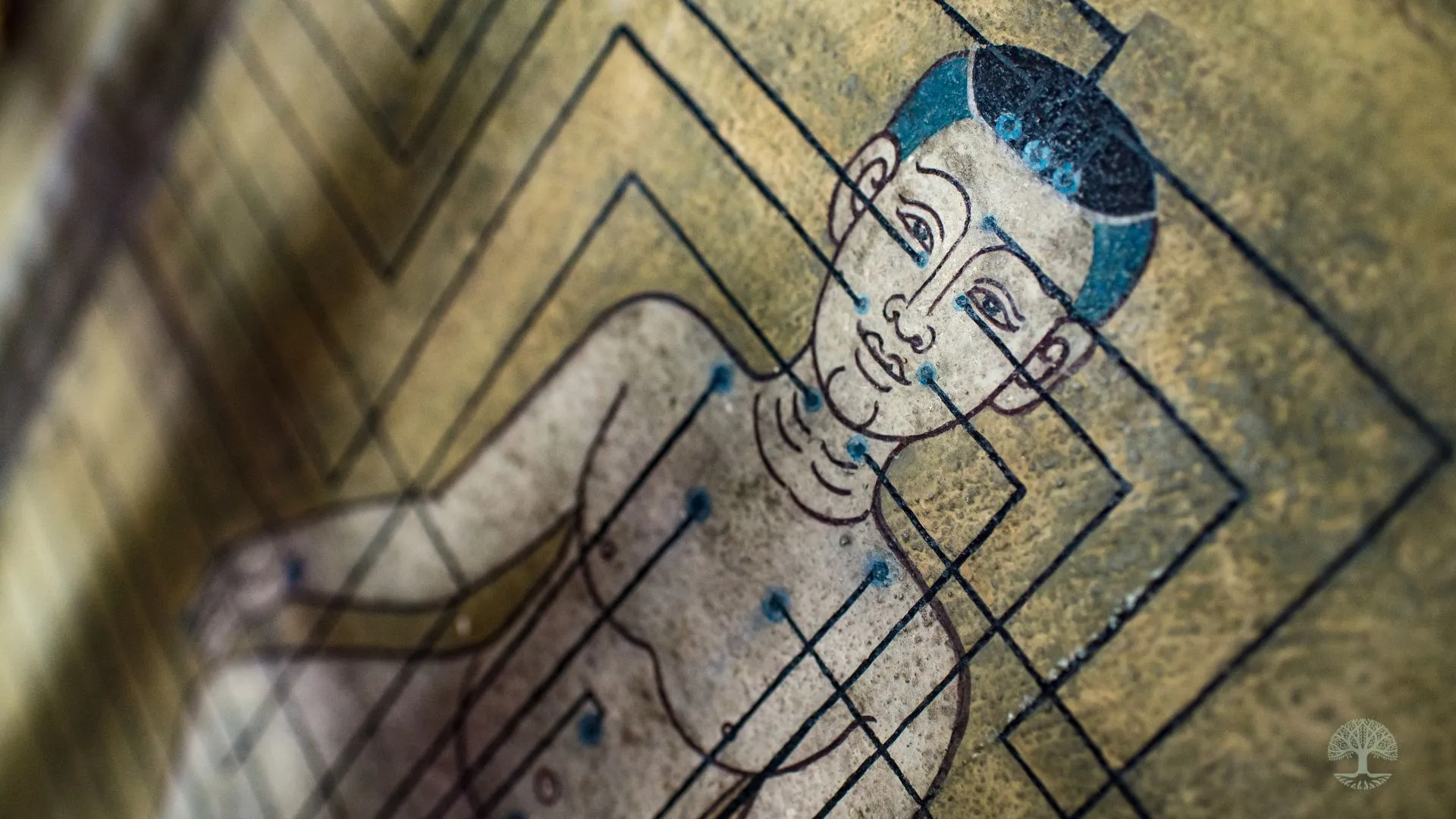
This principle forms an important foundation of acupuncture theory. Among other things, it explains why meridians at the surface of the body are seen as reflections of internal processes and organs. This makes it possible to get an idea of internal imbalance through observation, listening, feeling and asking.
Mental and emotional symptoms are at least as important as physical symptoms. In the TCM, body and mind are not seen as separate entities, but as a whole.
The five elements
When the body and mind are seen as part of a bigger picture, the question arises how healing takes place. For this, the theory of the five elements is essential. This states that nature is made up of five dynamic processes: wood, fire, earth, metal and water.
These elements influence each other by feeding or controlling. When they are in balance and in tune with the environment, there is health. Each element corresponds to organs, body structures, emotions, seasons, and other aspects of human functioning (2).
It is remarkable how intuitive many of these connections are. For example, the wood element is associated with growth and spring, and with emotions such as anger. When growth is stunted, frustration or anger can occur. In balance, this same element actually translates into strength and resilience.
Within this vision, a distinction is made between emotions and virtues. Both come from the same element, but emotions are unbalanced, while virtues are expressions of harmony.
Body, mind and emotions
The relationship between body and mind is often shown in the TCM as a trinity: Jing, Qi and Shen. These are also known as the three treasures.
Jing stands for essence and material basis, Qi for energy and movement, and Shen for mind and consciousness. In life, it's important to cherish these three and not waste them. They are also a development direction: from the physical body through emotions and energy to spiritual refinement.
A familiar metaphor is that of a burning candle: Jing is the wax, Qi is the flame, and Shen is the light and heat that is released.
Emotions and Qi
Emotions play a key role in the relationship between body and mind. They influence the movement of Qi and form the link between the outside world and our inner experience.
When emotions are appropriate and temporary, they are not pathological. Problems arise when emotions are too intense, too prolonged, or contextually present. Then they interfere with the movement of Qi. Qi, like water, should keep flowing. When this does not happen, stagnation occurs.
Different emotions influence Qi in different ways. Anger, for example, can raise Qi, resulting in complaints such as headache or redness. Prolonged stagnation can lead to further disturbances, such as accumulation of blood or fluids.
This can lead to a vicious cycle in which physical complaints reinforce emotions and emotions in turn deepen physical symptoms.
Acupuncture
Acupuncture uses needles to stimulate specific points on meridians. The goal is to influence Qi and activate the body's self-healing capacity.
The choice of points is based on the classification according to Yin and Yang and the five elements. Depending on the situation, energy is fed, moved or regulated to remove blockages.
Acupuncture is particularly suitable within the body-mind framework because it acts directly on the Qi mechanism, which forms the bridge between physical and mental processes.
Mindfulness and awareness
The question of how best to cultivate the mind leads to the concept of mindfulness. This means, among other things, thinking and observing without judgment, with attention and openness.
Within the TCM, the heart plays a central, harmonizing role in this. Cognition and analysis are important, but only come after inner peace. Only with an open and unbiased attitude can emotions really be recognized and treated.
A healthy lifestyle — including daily exercise, meditation and nourishing food — is therefore an essential part of disease prevention (4).
TCM and complementary and alternative medicine
TCM's philosophy is closely linked to contemporary discussions about body and mind and can make a valuable contribution to Complementary and Alternative Medicine (CAM).
While Western medicine often looks for measurable and tangible abnormalities, TCM focuses on subtle signals and early disruptions. As a result, complaints can be recognized and supervised at an earlier stage, when the self-healing capacity is still easy to address.
This perspective is an important starting point in our acupuncture treatments.
References
- Ni, M. (1995). The Neijing Suwen, p. 265. Shambhala.
- Fruehauf, H. (June 2009). All Disease Comes from the Heart. Journal of Chinese Medicine.
- Larre, C., & Rochat de la Vallee, E. (2005). The Seven Emotions. Monkey Press.
- Wilms, S. (2012). Nurturing Life in Classical Chinese Medicine. Journal of Chinese Medicine.