PMS - major influence on women's well-being
PMS can manifest itself before, during and after menstruation and has a major impact on daily life. Chinese medicine looks beyond hormones and focuses on restoring rhythm and balance in the body. By removing blockages and better coordinating processes, complaints can often be significantly reduced.
Here it is full blog revisited, with the H2 heads integrated, remained the same in terms of content and without extra frills.
Around 25% of women suffer from PMS — Pre Menstrual Syndrome — symptoms that are linked to menstruation. Sometimes the term Peri Menstrual Syndrome is also used. In practice, I think that's a better description, because complaints occur not only before menstruation, but also during and after.
What is PMS?
PMS has over 200 possible symptoms. The symptoms can vary greatly from person to person and even change per cycle. So it's not about one fixed pattern, but about a broad spectrum of physical and emotional signals.
Common PMS complaints
Common complaints include:
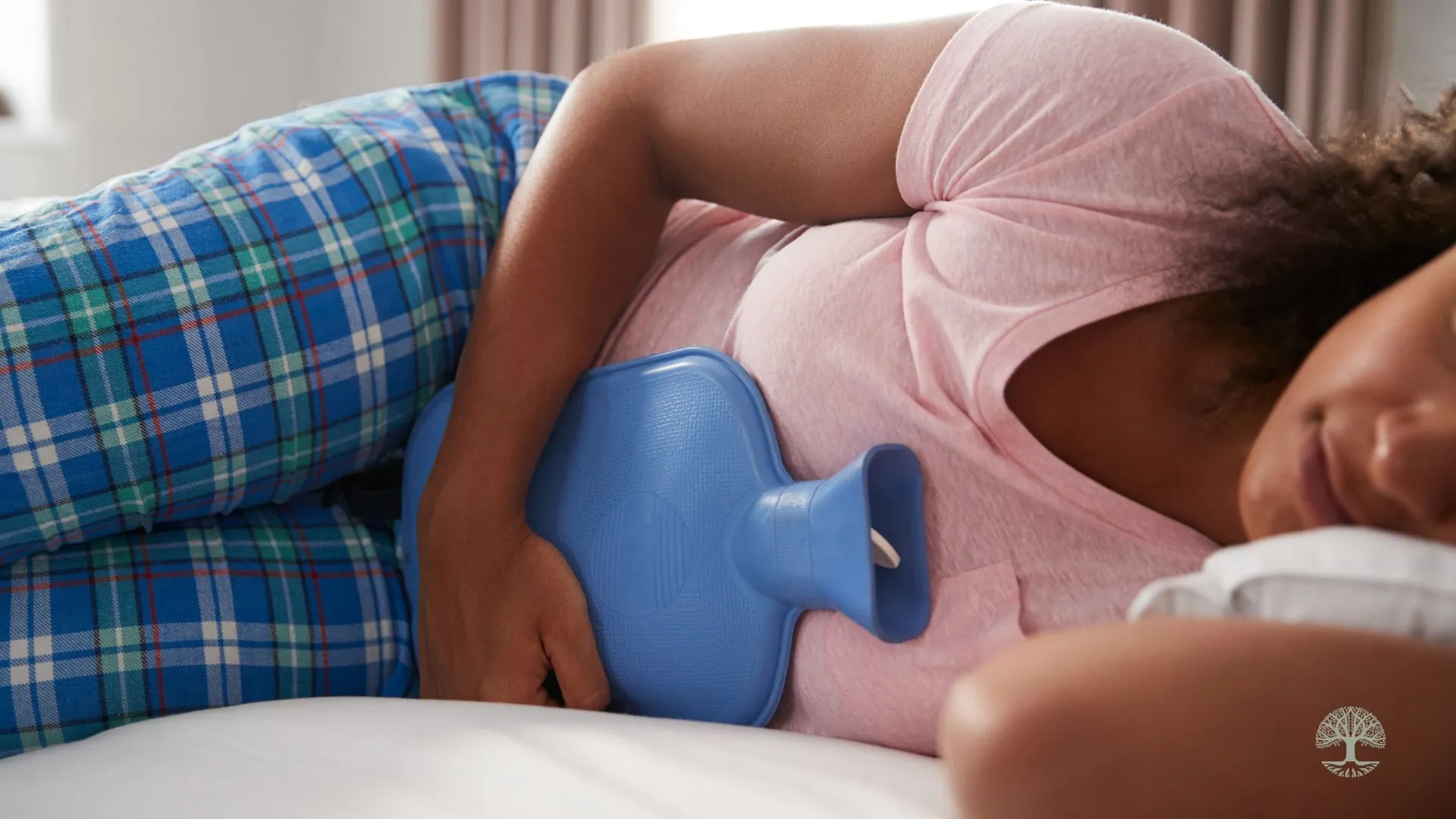
Physical: acne, breast tenderness or pain, bloating, lower back pain, headache or migraine, abdominal cramps, constipation or diarrhea, and joint pain.
Mental and emotional: tiredness, irritability, irritation, aggression, trouble sleeping, stress, changes in libido and mood swings.
The cycle as an important measure
In addition to the complaints themselves, the cycle also provides a lot of valuable information. Think of an irregular cycle, much or little blood loss, clots, dripping or pain at specific times. When treating PMS, menstruation as a whole is therefore always included and balanced.
The impact of recurring complaints
Because these complaints often recur, the idea quickly arises that they “belong”. Many women think that pain, acne, or mood swings around menstruation are normal. In principle, this is not the case. An almost pain-free cycle should be the starting point.
It is precisely the repetitive nature of PMS, the feeling that there is little to do about it and the fear that symptoms will worsen that make the burden considerable. In practice, I regularly see that women are out of balance for up to three weeks a month: two weeks before menstruation and another week afterwards. This means that someone is struggling with complaints for most of the month.
Fortunately, relief can often occur relatively quickly. Depending on the situation, it can take up to a few months before a stable and sustainable balance is restored.
Regular treatment of PMS
PMS is called a syndrome because the cause cannot be determined unambiguously. It is often assumed that hormones play the leading role, although this has not been fully proven. The regular treatment therefore regularly consists of hormonal therapy.
Hormone treatment can help, but can also cause new symptoms. The hormonal system is highly sensitive; small changes can trigger a chain reaction of effects. In the case of serious complaints, it is logical to choose this, but it also makes sense to look more broadly at underlying causes.
Coordinating processes in the body
Chinese medicine looks at PMS differently. Hormones are seen here as messengers or representatives. They carry out tasks that are controlled from the body, such as maturing eggs or building up the endometrium.
The body works through a series of interrelated cycles that influence each other. When these processes are well coordinated and run in the right rhythm, menstruation remains largely symptom-free.
A simple comparison is that of traveling by bus and train. Both have their own schedule and normally connect to each other. When one link is delayed, congestion and disruptions occur. In the body, something similar happens when processes are not properly coordinated.
A systematic approach according to Chinese medicine
In reality, the body is of course much more complex than a bus or train connection. Thousands of processes are at play at the same time, influenced by factors such as contraception, medication, pregnancies, miscarriages or IVF processes.
The strength of Chinese medicine is that this complexity can be made clear. Complaints are recognized as patterns. For example, irritability and bloating are often associated with Qi stagnation, while clots and stinging pain are associated with blood stagnation. By treating these patterns in a targeted manner, a complex situation becomes manageable.
Treatment with Chinese medicine
The aim of the treatment is to restore the body's natural rhythm and balance. In practical terms, this means that blockages are removed and waste products are cleaned up so that processes can run smoothly again.
You could compare it to a coach who organizes the team in such a way that everyone can play their role again. In practice, this usually means that:
— blockages are removed
— waste is disposed of
— improvement is often noticeable within a few weeks
What can you do yourself against PMS?
You can already do a lot yourself to reduce complaints:
— Get enough exercise in the week before menstruation
— Avoid dairy and cold drinks; eat and drink hot as much as possible
— Use herbs such as fresh ginger, fresh mint, peach seeds (the tiny seeds), and turmeric in food or tea
— Take extra rest in the days after menstruation
Questions?
No person and no cycle are the same. If you want to discuss your situation, please feel free to contact us. We'd love to help you.
References